Raghvendra
← All selected work

Founder & Ventures

GWK Ghostwriter

A personal AI LinkedIn studio — memory, voice, and a research-to-post workflow

Role
Founder / product builder
Timeline
2026
Engagement
Founder product
GWK Ghostwriter — A personal AI LinkedIn studio — memory, voice, and a research-to-post workflow

Situation

As Growing With Kid’s founder, I needed LinkedIn posts that sounded like me — grounded in source material I trusted — without rebuilding voice from a blank prompt every session. Generic AI tools forgot preferences, drifted tone, and treated research as disposable chat. The business need was a repeatable research-to-post workflow I would actually run.

Build story

Problem
Generic AI tools forgot voice, sources, and what worked — LinkedIn drafts drifted every session.
Bet
A memory-backed research-to-post studio with human approval beats a smarter prompt box.
Build
Product definition, experience architecture, memory model, voice rules, research-to-post workflow, and live prototype surfaces — founder-built end to end.
Ship
Live prototype and landing path — a runnable research-to-post studio with human approval before publish.
Learn
Voice rules as system state reduce drift more than longer prompts; memory without forget rules can become a junk drawer.

At a glance

User
Founder-operator publishing LinkedIn for Growing With Kid
Problem
Generic AI forgot voice, sources, and what worked — drafts drifted every session
My mandate
Full product ownership of memory model, voice rules, and research-to-post workflow
Hard decision
Memory-backed studio with human approval over prompt chat or autonomous posting
Result
Runnable research-to-post prototype with persistent voice and source handling

People affected

Primary user: myself as founder-operator publishing for Growing With Kid. Secondary: the same studio grammar intended to extend to Bolo Buddy and client tools without becoming a generic content mill.

The apparent problem

“I need better prompts” — as if quality lived in wording the model once correctly.

The problem underneath

Voice, beliefs, sources, and what worked last time were not system state. Without memory, scoring, and human approval boundaries, the tool optimised for fluent text that still failed the job: posts I could stand behind.

My mandate

I owned
Product definition, experience architecture, memory model, voice rules, research-to-post workflow, and the live prototype surfaces.
Others owned
No separate product/engineering org — founder-built. Model providers supply generation; I own when drafts may publish.
Final decisions
Founder — final call on what ships and what the model is allowed to remember.
Team
Solo founder / product builder.
Authority
Full product authority inside the venture.
Delivery constraints
Had to ship a runnable studio, not a deck — including landing conversion — while keeping human approval before anything public.

Constraints

  • Generic chat UIs erase session context and encourage voice drift.
  • Source material must stay attributable — research cannot silently invent.
  • Publishing requires human approval; the model recommends, the founder decides.
  • Studio grammar should extend to sibling products without becoming a prompt marketplace.

Critical decision

Situation

Build either a smarter prompt box or a system that remembers voice, sources, and feedback across sessions.

Options considered

  • Prompt-centric chat with saved snippets

    Still treats every draft as a new conversation. Voice rules and sources stay outside the product’s memory.

  • Fully autonomous posting from calendar

    Removes the human approval boundary. Brand and factual risk too high for a founder voice product.

  • Memory-backed studio with research → score → draft → preview → schedule

Observation

Running LinkedIn drafts in generic tools produced fluent posts that still drifted tone and ignored prior feedback. Source chats were hard to reuse. The job failed at continuity, not at sentence quality.

Insight

A full studio costs more surface area (dashboard, editor, knowledge, analytics) than a chat widget — but only a system with memory can stop voice drift.

Response

Ship a personal LinkedIn studio where preferences, style, feedback, and topics persist; ideas are scored from sources; drafts preview as LinkedIn; scheduling and analytics close the loop — always with human approval before publish.

Result

A workflow I can run: research to post with long-term memory and voice rules. Observed: live prototype and landing path; usage quality is directional while the product is still founder-operated.

  • GWK Ghostwriter — after-decision 1
    Landing as the product’s conversion path — not a separate moodboard from the studio itself.
  • GWK Ghostwriter — after-decision 2
    Dashboard as the job, not a chat log: ideas, calendar, and status replace “paste a prompt and hope.”

How the system changed

  1. 01

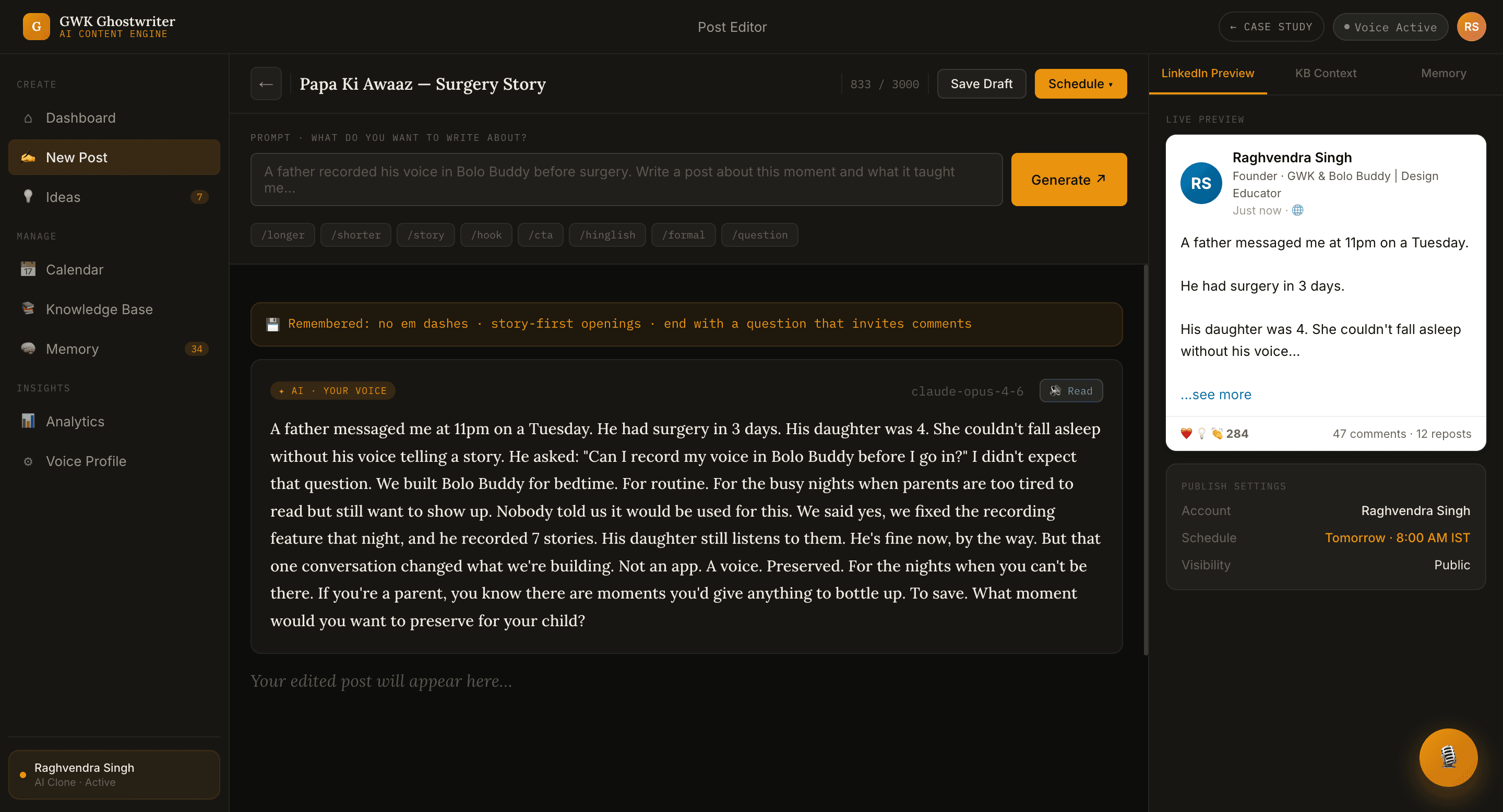
    Replaced the blank-prompt habit with a dashboard, post editor with live LinkedIn preview, ideas, calendar, knowledge base, memory, analytics, and voice profile.

  2. 02

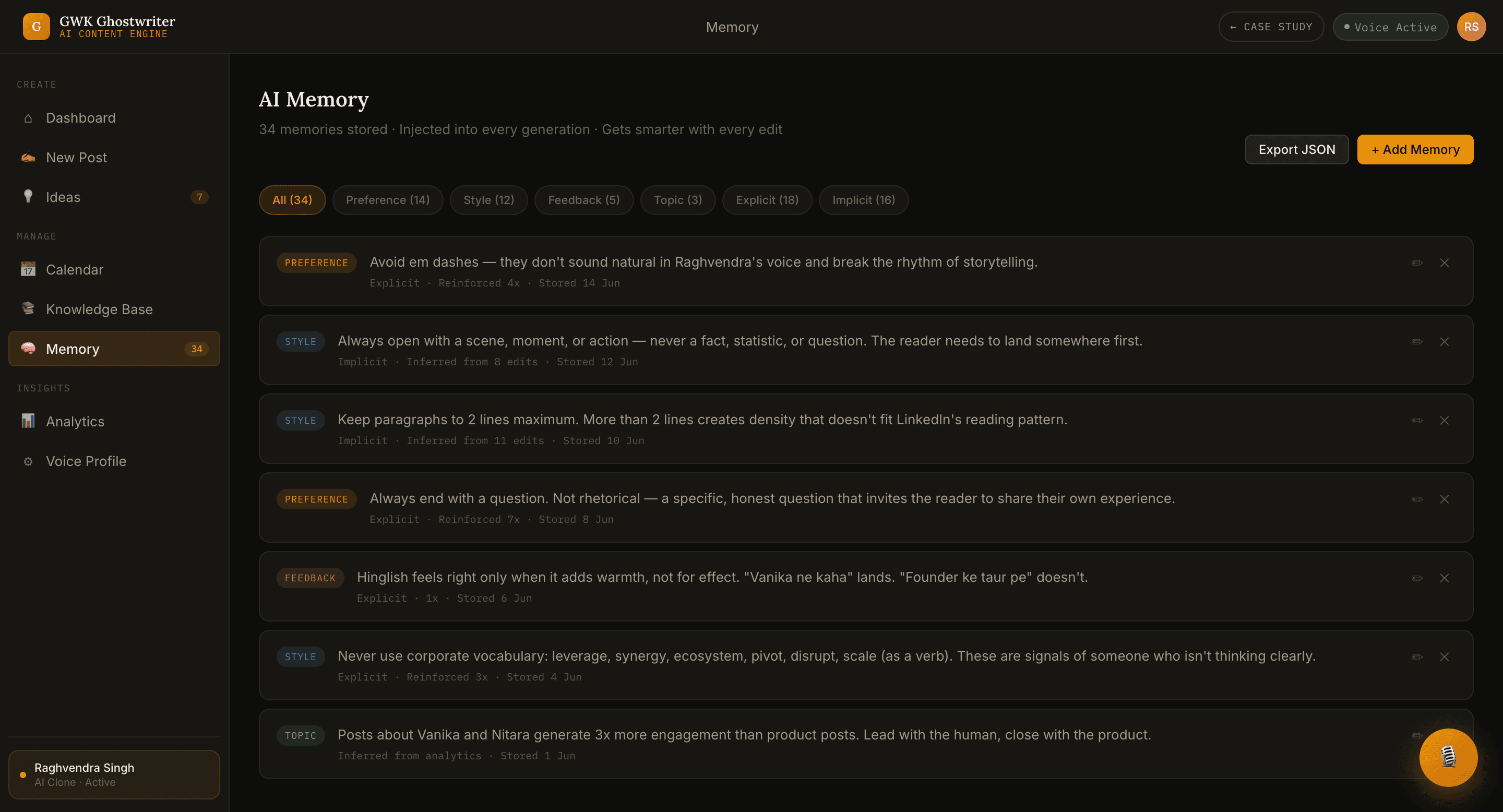
    Made memory core — preferences, style, feedback, and topics persist so the next draft already knows the rules.

  3. 03

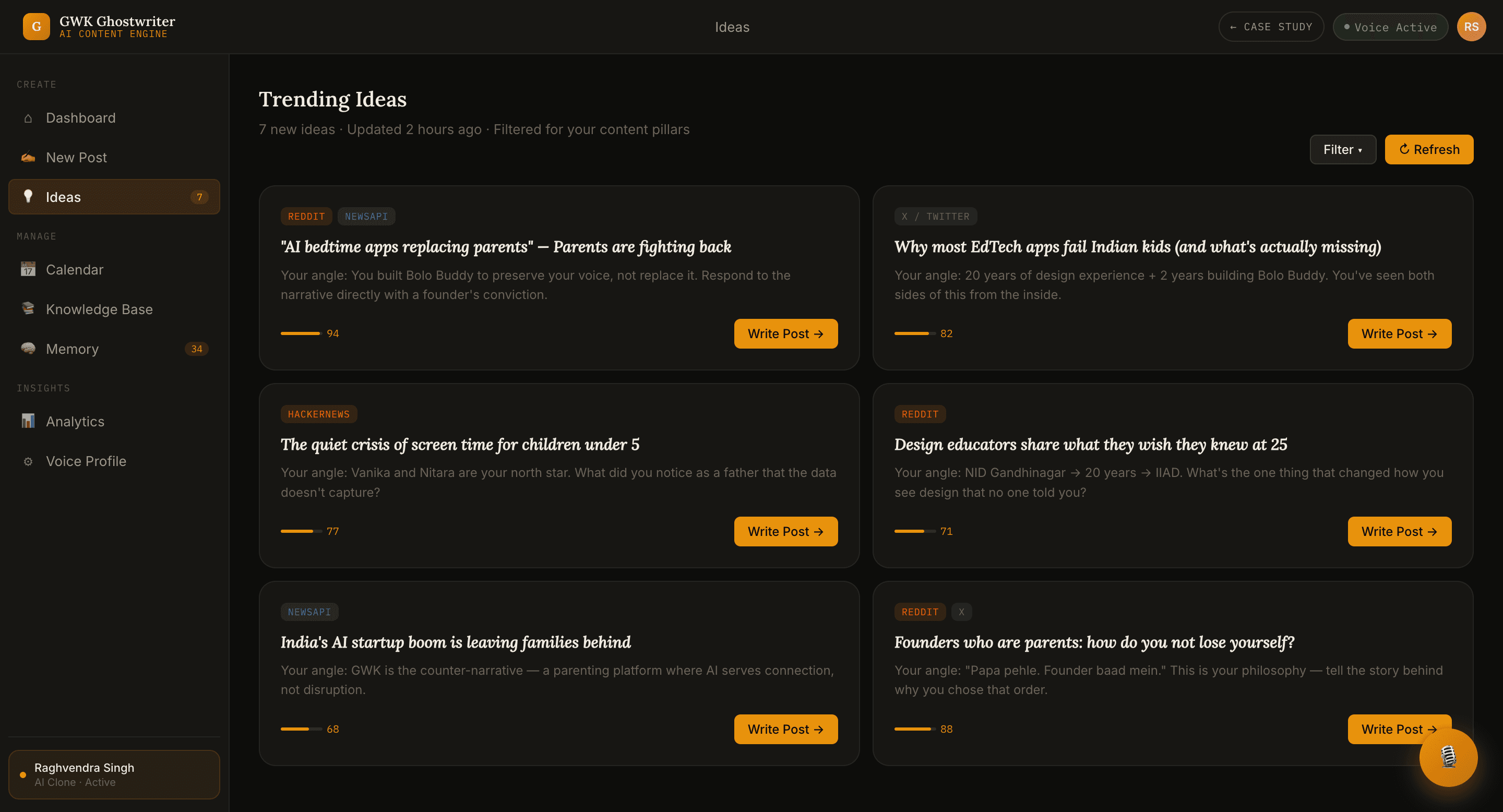
    Connected research to post: score ideas from source material, draft, preview, schedule, then read performance back into the studio.

  4. 04

    Kept human approval as a hard boundary — the model never publishes alone.

  5. 05

    Wrote the landing page as the product’s own conversion path, not a separate moodboard.

  • GWK Ghostwriter — after-system-change 1
    Editor with live LinkedIn preview: see the post as it will ship before human approval.
  • GWK Ghostwriter — after-system-change 2
    Ideas bank: score and queue draft angles from source material instead of starting from a blank prompt.

Validation and iteration

  • Voice drift in early drafts

    Without a durable voice profile, drafts sounded “AI-helpful.” Explicit beliefs and style rules in memory reduced drift more than longer prompts.

  • Source handling

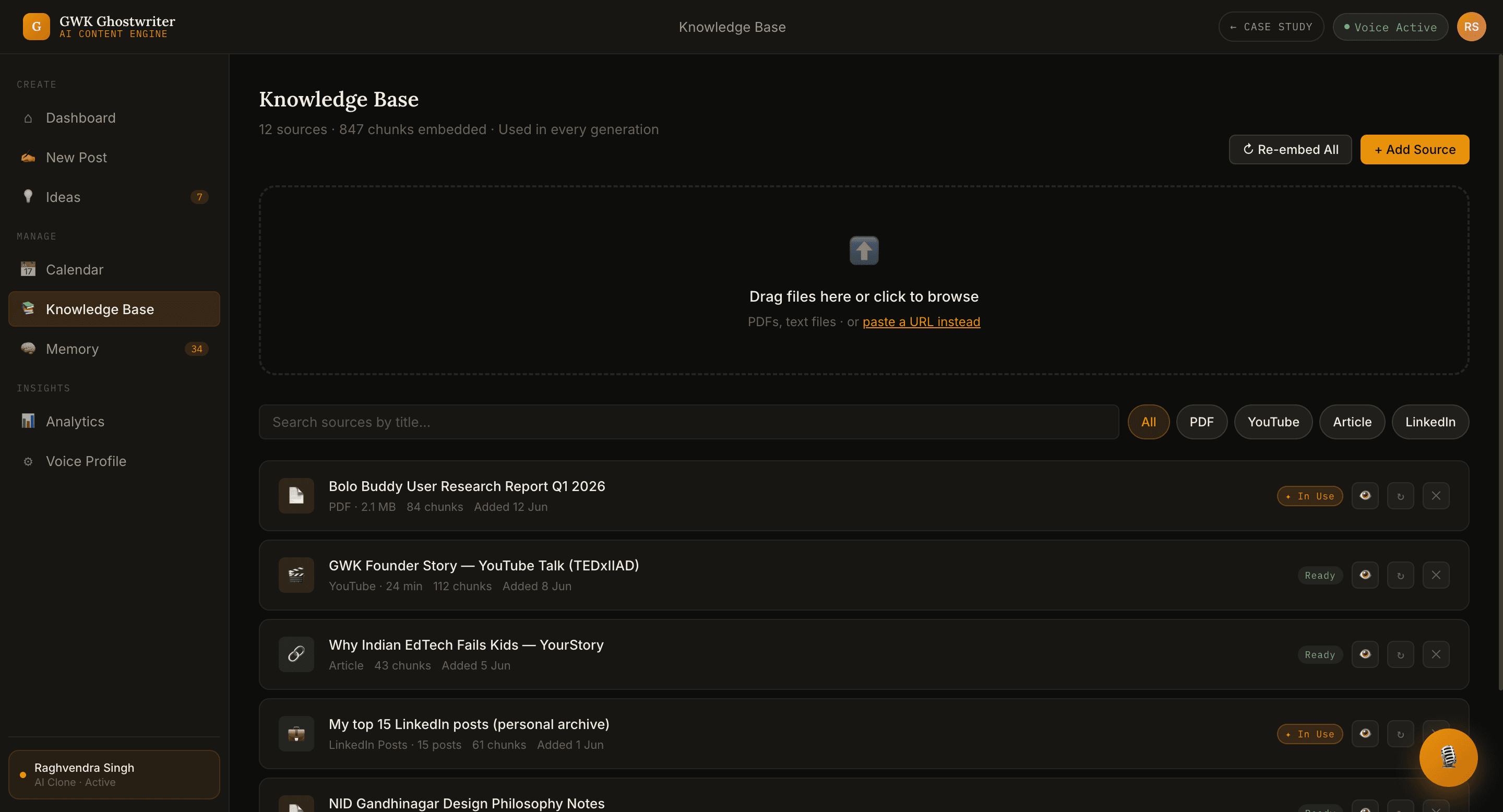
    Knowledge-base material had to stay inspectable. Silent synthesis was rejected in favour of scored ideas tied to sources the founder can open.

  • What still fails

    Memory can overfit recent feedback. Forgetting and re-weighting what to remember remains an open product question.

Outcome

operational

Operational: runnable workflow

Research-to-post loop with memory, voice rules, and source material a founder can operate end to end.

organisational

Organisational: voice as system

Writing rules and sources live in memory and knowledge — not in a one-off prompt.

business

Business: pattern that can extend

Same studio grammar can serve Growing With Kid, Bolo Buddy, and client tools without becoming a generic mill — directional until those extensions ship.

Product

  • GWK Ghostwriter — Product 1
    Knowledge and sources: research stays inspectable so drafts pull from material you trust, not silent invention.
  • GWK Ghostwriter — Product 2
    Long-term memory: preferences, feedback, and topics persist across sessions — the constraint that beats prompt theatre.
  • GWK Ghostwriter — Product 3
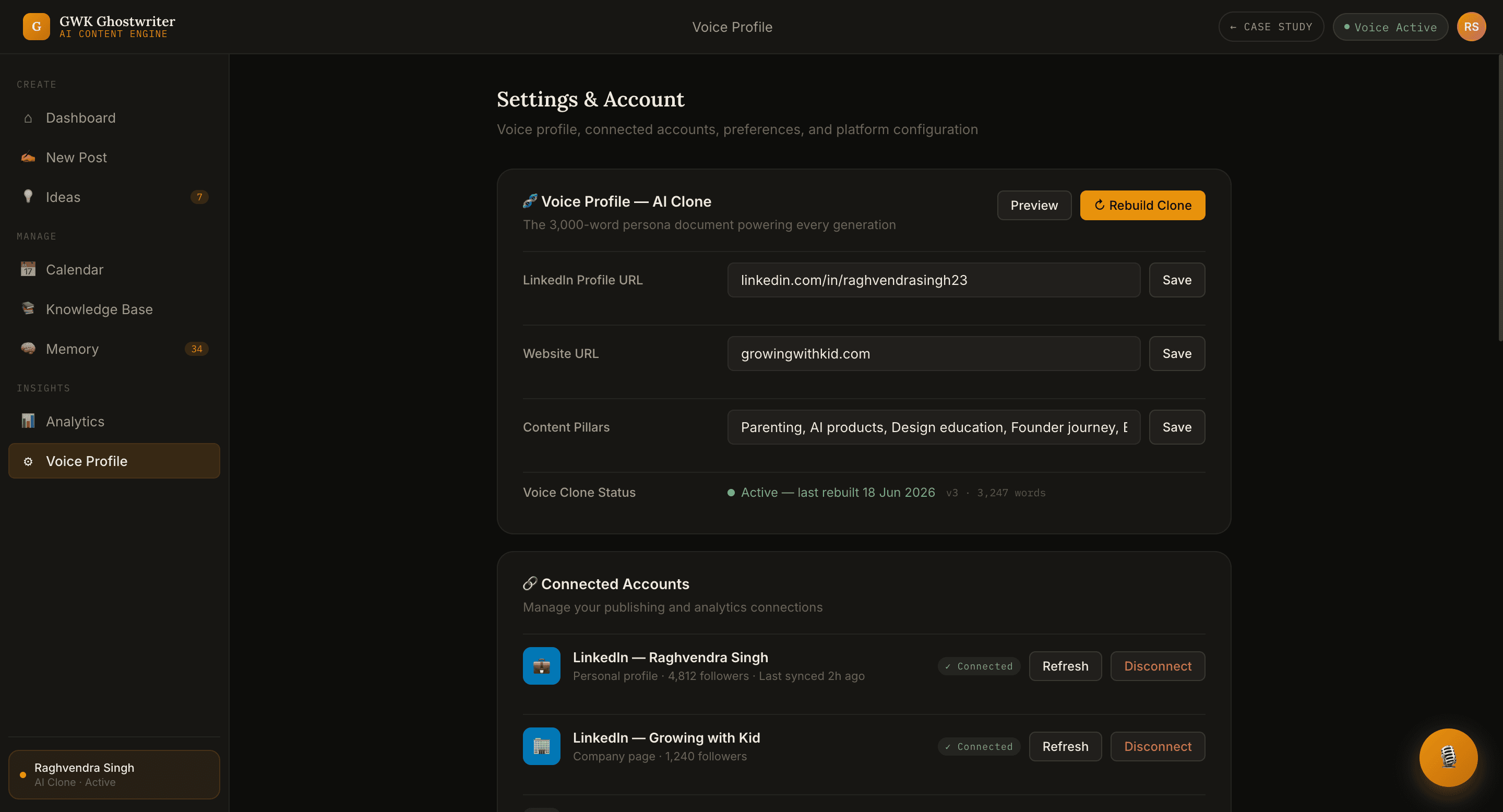
    Voice profile: beliefs and style rules live as system state so drafts stop drifting into generic AI-helpful tone.
  • GWK Ghostwriter — Product 4
    Calendar closes the research-to-post loop: schedule drafts while keeping publish under human approval.
  • GWK Ghostwriter — Product 5
    Analytics feed performance back into the studio so “what worked” becomes system state, not a forgotten impression.

What I would change now

I would instrument before/after draft acceptance rates against a fixed voice rubric earlier, and define explicit forget rules so memory does not quietly become a junk drawer of every past preference.

Have a similar challenge?

Work with me.

Start a conversation